
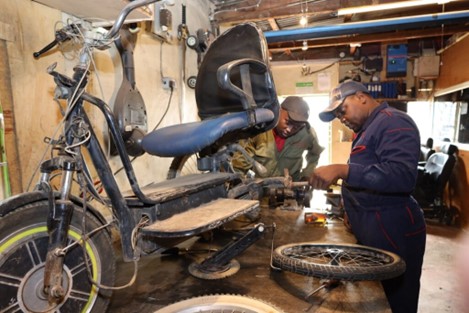
Globally, the World Health Organization estimates that nearly 2.5 billion people need at least one assistive product today, rising to 3.5 billion by 2050. In the global south specifically Sub-Saharan Africa, only a small fraction of people who need AT can access it. This is not a demand problem; It’s a systems problem. How we finance, purchase, and deliver assistive tech makes access the exception, not the norm. In other words, the tap isn’t dry; the pipes are broken. Fix the pipes, and the water flows!
Across Africa, assistive technology (AT) is still treated as a charitable add-on, something nice to have once basic needs are met. That thinking is not benign. It is exclusion by design. For millions of Africans who rely on mobility aids, hearing and vision technologies, communication tools, and AI-driven accessibility to learn, work, and live independently, the reality is stark: access remains the exception, not the norm.
AT spans wheelchairs and prosthetics, hearing aids and screen readers, communication devices and accessible software. These products are not luxuries, they are the entry ticket to education, employment, healthcare, and civic life for persons with disabilities. Without them, potential is capped, livelihoods are foreclosed, and dignity is compromised.
Africa has the potential to become the world’s most dynamic and lucrative hub for inclusive innovation, serving an estimated 250 million people who need assistive technology, representing one of the largest untapped consumer markets globally. Powered by a bold generation of young innovators, expanding digital infrastructure, and a rapidly maturing tech ecosystem, the continent is uniquely positioned to turn unmet accessibility needs into scalable, investment-ready solutions. ‑of‑concept, unable to cross the “valley of death” and reach scale.
Quantifying the funding Gap: Africa vs the world
Despite this huge demand, the assistive technology sector in Africa remains chronically underfunded compared to India and more mature innovation ecosystems. In 2024, Africa captured roughly 0.6% of global startup funding and within that already limited share, capital directed specifically toward AT is largely grant-dependent. By contrast, India has launched a dedicated US$600k seed fund for AT startups under the Startup India Seed Fund Scheme, while Remarkable deploys $100,000 (for 5% equity) in its Australia+ program and $50,000 in its US program. These are dedicated, structured capital pools for assistive technology.
With no continent-wide, dedicated AT seed fund of comparable scale, African AT startups are left to piece together small grants, short accelerator programmes, or compete in general health-tech pools. The result is a pipeline rich in innovation—but starved of the capital required to turn prototypes into products and scale impact.
Structural barriers entrench the gap. National insurance rarely covers AT comprehensively. Procurement is slow, opaque, and biased toward imports. Research and design for disability innovation is a rounding error compared to fintech or agritech.
Universal Health Coverage (UHC) is the natural home for Assistive Technology. WHO is explicit: including assistive products within UHC benefit packages is essential to realize the right to health and unlock education and employment gains. Yet even where policy has moved, practice lags.
In Kenya, the Social Health Insurance Act (2023) created the Social Health Authority (SHA) and a consolidated benefits package, on paper a step toward funding and purchasing AT through public insurance. However early SHA guidance and stakeholder analysis show restricted eligibility and resource contingent limits on assistive devices, and uneven rollout—meaning many people still cannot obtain the devices they’re entitled to.
Finally, where systems are redesigned, outcomes follow. For example, is the case of hearX Group (South Africa) began with a simple idea: use smartphones to make hearing tests and hearing aids more affordable and accessible. Today, the company has raised nearly US$60 million, generated tens of millions in revenue, expanded internationally, and completed a merger valued at over US$100 million.
It is a powerful proof point: assistive technology built in Africa can scale globally and attract serious capital. These are not charity stories. They are venture-scale businesses. Now imagine the multiplier effect.
If Africa had a US$5–10 million continent-wide assistive technology seed fund, backed by structured accelerator programmes and coordinated investor networks focused on disability tech, the ripple effects would be transformative. more manufacturing and tech jobs, fewer AT imports, export-ready innovations, and stronger health and education systems. For persons with disabilities, affordable AT would mean higher school retention, increased employment and independence, and greater earning potential—lifting household incomes and overall productivity. And for founders, the right investment structures would turn local problem-solving into globally competitive companies.
We don’t need incremental tweaks. We need a strategic reset—from charity mindsets to investment-led transformation. The funding gap isn’t a bug in the system; it’s the product of what we value, what we measure, and who we design for. The question is no longer whether Africa can afford to fund assistive technology. It’s whether we can afford the cost of not doing so!